
Federal BOP Release Scope
The Federal Bureau of Prisons is a nationwide prison system. It is not part of the Prince William–Manassas Regional Adult Detention Center, the Virginia Department of Corrections, or the county court system. The researched Prince William facility map identifies no county-based BOP prison. A person connected to Prince William may still enter federal custody through a federal prosecution, designation, contract placement, or transfer, but the BOP locator remains a national search.
The BOP Inmate Locator generally covers federal records from 1982 to the present. Older federal prison records may require the National Archives. Its displayed release date and location describe the BOP record. A location of “RELEASED” means the person is no longer in BOP custody. It does not establish that the person has no supervised release, state sentence, local hold, ICE custody, or later case.
Search Federal BOP Release Records
Use the official BOP Inmate Locator. Identifier searches are the strongest starting point because a name can match more than one person. BOP supports the federal register number and several other agency-number types. A name search can add supported demographic fields to narrow results.
- Select the number search when a BOP register, DCDC, FBI, or INS number is known.
- Otherwise enter the person's name and use the supported age, race, or sex fields only to distinguish likely matches.
- Compare the returned name, register number, age, race, and sex with the known federal case.
- Read the exact release date and location shown. Record the search date as well.
- If the location is “RELEASED,” state only that BOP custody ended as displayed.
- Review the federal court docket and any next-system evidence before describing current freedom or supervision.
The successful manifest capture below shows the official federal locator and released-result labels.
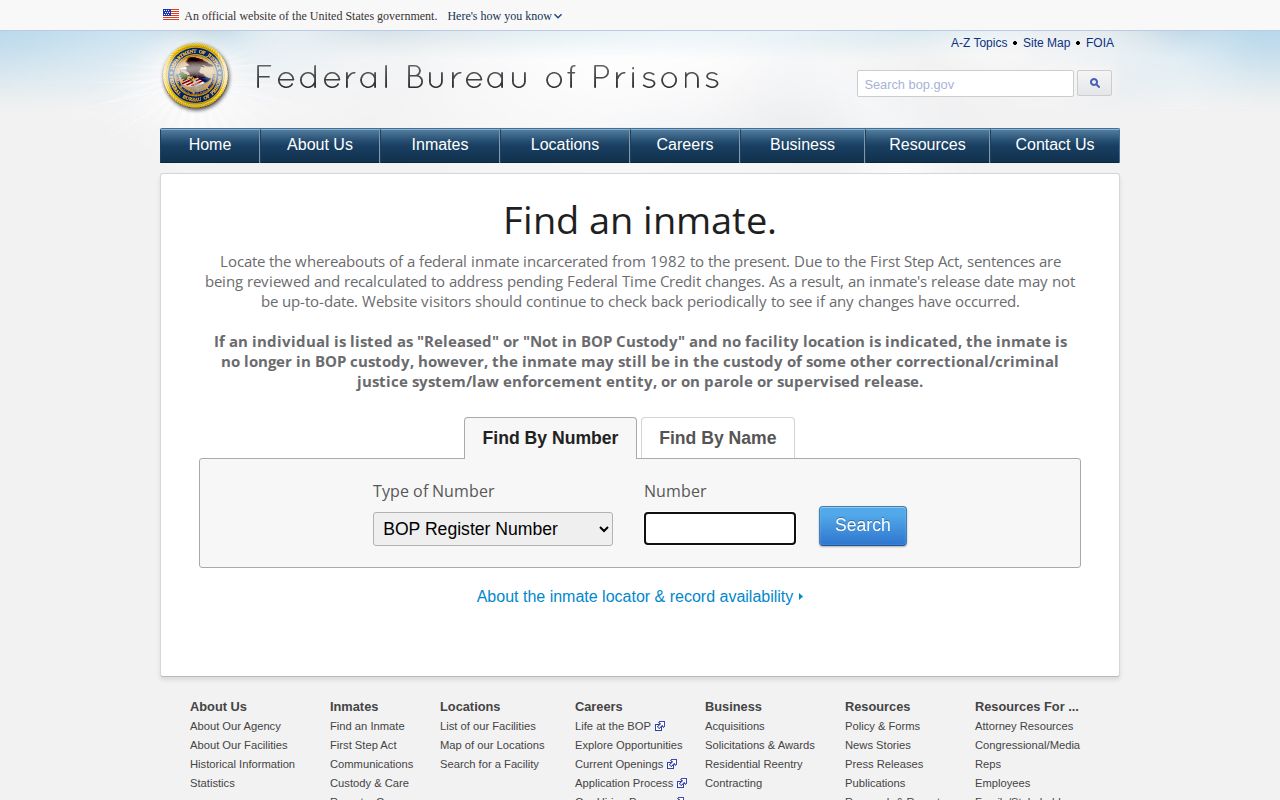
The image illustrates the source to use, not a county-specific release feed or permission to choose a person by name alone.
Federal Release Result Fields
A BOP result supplies a small, system-specific field set. Each field helps confirm identity or the federal custody endpoint, but none replaces the case docket or a receiving-agency check.
| Displayed field | How to read it |
|---|---|
| Name | The identity shown in the federal locator; compare it with the court and identifier. |
| Register number | The strongest key connecting the locator result to a BOP record. |
| Age, race, and sex | Supporting identifiers that reduce namesake error but do not stand alone. |
| Release date | The federal custody date shown by BOP, which may reflect calculations and later updates. |
| Location | The institution or “RELEASED” status displayed within the BOP system. |
A released result should be recorded exactly. Do not convert “RELEASED” into “released from Prince William County,” since the local ADC is a different custodian. If the same person previously left ADC for federal authorities, the ADC transfer record and the later BOP release are two separate custody boundaries.
Federal BOP Release Date Changes
A displayed federal release date can change. BOP warns that First Step Act calculations may affect dates, and sentence computation can also reflect court action and federal records work. Treat a future date as a current projection rather than a guarantee. Preserve the date on which it was viewed, then look for the later “RELEASED” location or another official event after the date passes.
The federal court judgment explains the sentence but may not equal the prison release date. Credits, amended orders, consecutive or concurrent terms, and other lawful calculations can affect the operational date. If a result conflicts with the docket or another notice, confirm the current BOP record rather than calculating the date from the sentence on one's own.
| Date source | What it establishes |
|---|---|
| Federal judgment | The sentence ordered by the court, not necessarily the completed custody endpoint. |
| Future BOP release date | The date displayed by the federal custodian at the time of the search. |
| BOP “RELEASED” result | That the locator reports the person outside BOP custody. |
| Supervised-release record | A separate community supervision stage after prison where applicable. |
Prince William Federal Custody Boundary
The county jail and BOP answer different questions. ADC Inmate Records can report current local information but does not confirm former inmates. If a person moved from ADC to federal custody, use the ADC FOIA channel for the local release transaction and its receiving-agency field. Then use the BOP locator for the federal stage. A missing ADC response cannot prove a federal transfer, and a BOP result cannot supply the ADC gate time.
The U.S. Marshals Service manages federal pretrial detention and transport. The research found no public historic USMS released-person locator comparable to BOP. For that stage, use the federal court docket, the last known contract facility, and the receiving federal system. Do not describe USMS as a county release roster.
A person may also move from BOP to ICE, state custody, or local custody. Those transitions require the locator or record of the next custodian. The Prince William release search explains how to preserve each boundary instead of merging them.
Federal and Local Release Differences
The same word can refer to separate agencies and dates. Identify the system in every statement so a BOP event is not mistaken for a Prince William ADC event. A local criminal order may be checked through the Prince William Circuit Court when that court handled the matter.
| Record | Scope | Limit |
|---|---|---|
| ADC release transaction | End of Prince William regional jail custody | Does not prove the end of later federal custody |
| BOP locator | Federal prison custody and displayed release result | Does not cover every USMS, state, local, or ICE event |
| Federal court docket | Judgment, orders, and case activity | May not show the exact prison departure time |
| ICE locator | Eligible immigration detention and limited recent-release scope | Does not establish BOP or ADC release details |
| VADOC locator | Virginia custody and community supervision | Is not a federal release archive |
Federal BOP Release Records
The public locator is the fastest official source for a covered federal record, but a formal record may be needed when the result is old, ambiguous, or contested. Use the register number and federal case information when contacting BOP or seeking a record. For records before the locator's general 1982 starting point, follow the BOP explanation toward the National Archives.
The BOP explanation of inmate records defines locator coverage and cautions about date changes. A records request should identify existing records and the precise custody question. Court records belong through the federal court access route. An ADC transfer belongs through the ADC record custodian. Keeping those requests separate makes each response easier to interpret.
- Designation
- The BOP institution assignment during federal custody.
- Register number
- The federal identifier used to match locator and case records.
- Release date
- The date BOP displays for the end of its custody stage.
- Supervised release
- Court-ordered federal supervision that can follow prison custody.
Federal BOP Search Contact
No Prince William BOP facility address or local BOP release desk was verified because the system is nationwide. Use the federal locator and its official records explanation. Contact or records routing should follow the institution or office identified in the current federal result rather than an invented county location.
When no result appears, recheck the identifier and name format, consider the coverage period, and consult the federal docket. Absence from BOP does not establish release from USMS, ICE, Virginia, or Prince William custody.
Confirm a Federal BOP Release
A well-supported federal release statement identifies the person by register number, quotes the displayed BOP location, includes the federal release date, and records when the locator was checked. It then states the limit: the finding applies only to BOP custody. If the court imposed supervised release, that is a later legal stage rather than prison confinement.
When a Prince William trail includes ADC, preserve the local transfer record too. When it includes ICE or a state system, check that custodian separately. A BOP “RELEASED” result is valuable because it is affirmative federal evidence, but accuracy depends on keeping its boundary clear.
Note: A federal release date should be rechecked after any First Step Act recalculation, amended order, or conflicting agency notice.
Match Federal Release Identity
A name match should be tested against the register number, supported demographic fields, and the federal case. This is especially important when a common name returns more than one record or when the court file uses a middle name that the locator shortens. The identifier links the search result to the correct federal custody episode.
If the record is older than the locator's general coverage, follow the National Archives route described by BOP. If a modern name search fails, retry with the number before concluding that no federal record exists. Spelling, aliases, and differences between a court caption and prison record can affect a search.