
Prince William 72 Hour Window
Prince William County has no official ADC, Sheriff, or county 72-hour release page. The official sweep found no other rolling recent-release view, no public ADC web roster, and no mobile app that provides a three-day list. Since there is no feed, there is also no official update cadence, released-row field set, photograph promise, or fixed online retention period to report. Any page that claims otherwise would be substituting an unofficial arrest product for a county release record.
The practical 72-hour window belongs in a focused request. Define the exact beginning and end, including local time, and apply that same range to the court and notice checks. This is broader than a same-day question. It can capture a release that occurred on the first day but was not discovered until the third, while still keeping the inquiry narrow enough to identify the right booking and limit cost.
Prince William Weekend Release Review
A three-day interval is useful when a custody question spans Friday through Monday or crosses a holiday. It allows separate court, VINE, and ADC events to be compared without assuming that an office's next business day is the day the person left. Yet no Prince William source establishes a special weekend-release rule or promises that a Sunday release occurs early on Friday.
The ADC states that scheduled releases begin at 7:30 a.m. every day. That statement includes weekends as a daily start for scheduled processing, but it does not guarantee an exit time or create a daily web update. Unscheduled court orders, bond processing, records checks, and transport can occur on their own timelines. A receiving agency also controls information after a transfer.
Keep the interval fixed even if confirmation arrives later. A record received on Monday may prove a Saturday release. The receipt date is not the event date. Likewise, a court docket entry posted later may explain authority for the release without proving the exact time ADC relinquished custody.
Check Prince William 72 Hour Releases
The three-day workflow is built around chronology. Create one event line for each agency record, then compare them. This reduces the risk of collapsing a bond order, jail departure, state admission, and later community release into one event.
- Define the 72-hour start and end in Eastern Time, and note the person's full name, aliases, identifiers, court locality, and last known custodian.
- Review saved Virginia Jail VINE messages for a release or transfer reported during that range. Preserve the timestamp and booking identifier.
- Search both Prince William adult court levels when the case stage is uncertain. Note the order date separately from the physical release time.
- Use the ADC current phone route only to establish whether the person is presently confirmed, not to obtain a former-inmate history.
- Request the existing ADC booking and release transaction for the exact three-day period.
- Trace any destination through VADOC, another jail, BOP, or ICE and label the transition between agencies.
- Resolve conflicts by favoring the event record closest to the custodian and date, while retaining the supporting court context.
A reader who needs only today's slice can use the Prince William last-24-hours method. Do not move a third-day event backward into the first day merely because the broader search found it.
Prince William 72 Hour Fields
No public Prince William list supplies standard columns. The following inventory describes the existing fields that a requester can seek from the ADC. It is designed to show whether one specific booking ended within the selected three days and where the person went.
| Record field | Role in a 72-hour review |
|---|---|
| Full legal name and aliases | Connects the event to the correct person while guarding against namesake error. |
| Booking or inmate number | Separates one custody episode from an earlier or later booking. |
| Booking date and time | Shows when the ADC episode began. |
| Actual release date and time | Places the ADC departure within or outside the defined three-day interval. |
| Release event or reason code | Identifies the custodian's recorded action when the responsive record supplies it. |
| Receiving agency or destination | Distinguishes community release from continued custody elsewhere. |
| Court and case number | Points to the order, disposition, sentence, or bond activity that may explain the action. |
These are requested record elements, not verified columns from a missing feed. Ask the ADC to provide the actual code meaning or data dictionary if a response uses an abbreviation. Never assign a release type based only on the date or on absence from current information.
Prince William Release Data Gap
The distinctive Prince William problem is not normal feed lag. It is the absence of an official feed combined with a firm current-only information policy. The ADC Inmate Records page says staff cannot release or confirm information about people no longer incarcerated or in transport. Current staff information covers current court status, charges, bond, the next court date, and a sentenced release date.
The official ADC Inmate Records source makes that current-only boundary clear.
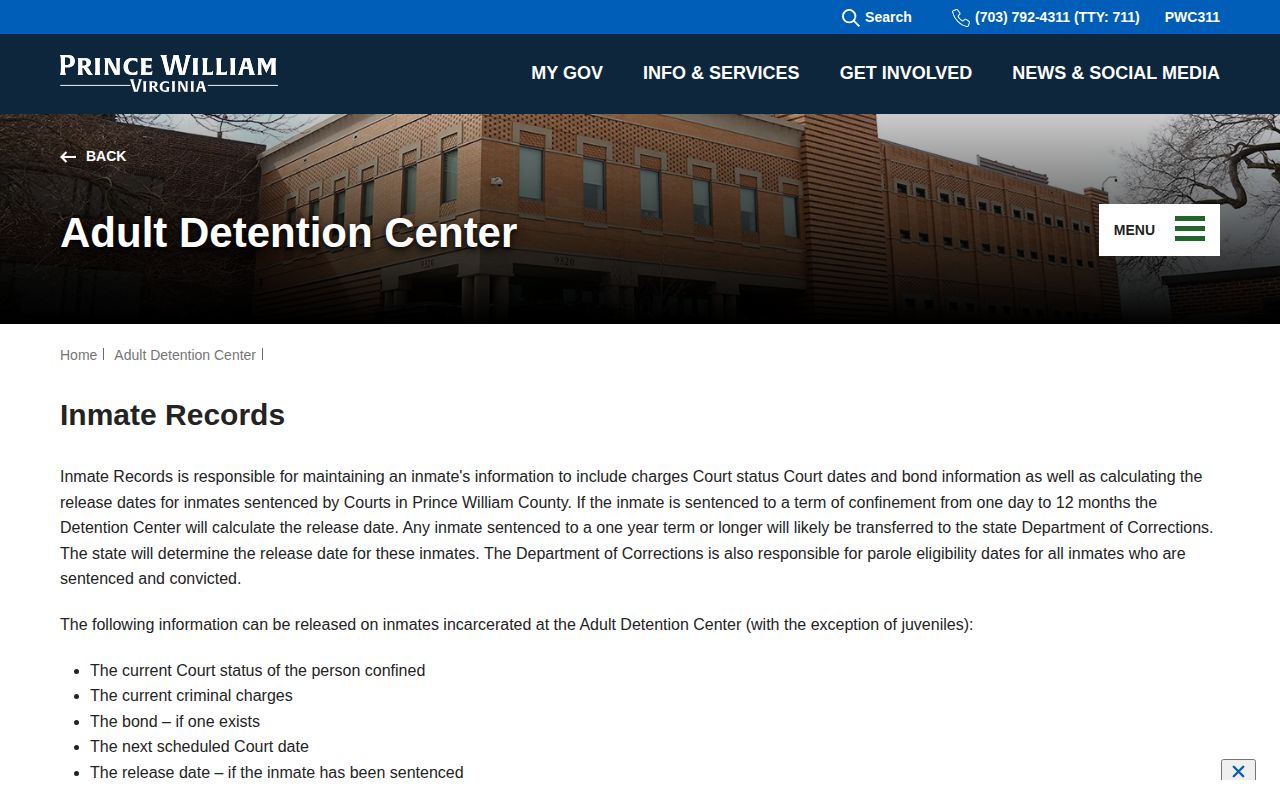
A no-result or refusal to confirm a former person leaves several live possibilities: community release, transfer, transport, a name mismatch, another booking system, or no ADC custody. The 72-hour review must replace that gap with affirmative evidence.
Note: State the narrow result accurately as “not currently confirmed at ADC” until a custody-event or destination record resolves what happened.
Prince William Release Court Sequence
General District Court and Circuit Court records can fall on different days within a three-day interval. GDC handles misdemeanors and felony preliminary stages. Circuit Court holds the felony final record and appeals. A GDC entry showing certification or transfer in a felony matter is not the final disposition. Search both courts when the custody change follows a felony case.
Review bond changes, dispositions, the imposed and suspended sentence, probation, appeals, and revocation activity. A dismissal or time-served entry can explain the legal basis for release. It does not provide an ADC departure timestamp. Another warrant or detainer may also continue custody despite an order in one case. Match the court event to an ADC transaction or a saved notification.
The wider period is especially useful when an order and its operational effect appear on different dates. Record both dates. Do not claim that administrative processing was delayed unless the official documents support that conclusion.
Request Prince William Three-Day Records
The ADC FOIA liaison accepts requests through the official web or email route, by phone at 703-792-4150, and by mail at 9320 Lee Avenue, Manassas, VA 20110. The ADC is separate from the county's central FOIA office and from the court clerks. Direct the custody transaction to ADC and seek court orders through the court's own access process.
A focused request can ask for “the adult booking/intake record and the release transaction showing actual release date and time, release reason or disposition code, and receiving agency or destination, if any, for [name and identifier] during [exact start] through [exact end].” Ask for existing records, electronic delivery, and an estimate before cost exceeds a stated cap. No fixed ADC FOIA fee schedule was found.
Virginia's FOIA response framework is generally five working days for production, written denial, no-record response, or notice that production is impracticable in that period. Such notice can add seven working days. Access and requester rules, exemptions, and actual-cost charges apply. A response deadline is not the same as the release date, and a no-record response does not prove the person was never held.
Prince William Release Transfer Chain
Three days can contain more than one custody boundary. A person might leave ADC for VADOC on day one, remain in state custody, and appear in the state locator after the local record ends. That sequence is one local release and an ongoing state confinement, not a community release. The VADOC locator also covers some community supervision and local-jail placements under state authority, so read the exact location and status shown.
Virginia Jail VINE can notify a registered person of a local jail release or transfer. Updates end after release, and the official material does not promise how long a released result stays searchable. Save the notice. For a federal matter, the BOP locator's “RELEASED” label applies only to BOP custody. For an immigration handoff, obtain the ADC destination record and then use ICE's locator. ICE's separate recently released window is not a Prince William three-day list.
| Sequence | Accurate description |
|---|---|
| ADC record ends, no receiving agency | Seek the release reason, court authority, and affirmative community-release evidence. |
| ADC to VADOC | Released from ADC and transferred to state custody. |
| ADC to ICE | Released from ADC to immigration custody, not into the community. |
| ADC event plus pretrial order | Released under court-directed pretrial conditions while the case remains open. |
| VADOC district-office result | Shown in community supervision as displayed, not incarcerated at that office. |
Confirm Prince William 72 Hour Releases
The final record should state the named person, booking, actual ADC release time, event type, and destination. Keep projected dates apart from completed events. Keep court authorization apart from gate time. Keep a transfer apart from release into the community. Those distinctions matter more in a three-day review because several records may appear within the same range.
If the trail stays unresolved, preserve the agency replies and return to the custodian closest to the missing event. The full Prince William released-inmate record process covers VINE, VADOC, courts, BOP, ICE, supervision, and older records. A precise unresolved statement is more reliable than a release claim drawn from silence.
Note: Use the actual event time for the 72-hour boundary, not the date a portal updated or an office supplied its response.