
VADOC Release Paths
VADOC is a statewide prison and community-corrections system. It is not the Prince William county jail. A person sentenced from Prince William may remain for a time at the regional ADC under VADOC authority and later transfer to a state institution anywhere in Virginia. The VADOC facility directory does not identify a state prison located within Prince William County, so a local address should never be invented for this system page.
A state release can lead to parole, probation or another form of community supervision, or full discharge. Parole is release under conditions after an authorized parole decision. Probation is court-ordered supervision and does not require a parole grant. Discharge means the relevant VADOC custody or supervision obligation has ended. A locator result at District 35 in Manassas points to community supervision, not incarceration, and it is not a retrospective ADC release list.
| VADOC stage | What it indicates | Best confirmation |
|---|---|---|
| State custody | The person remains confined under VADOC authority, even if housed temporarily in a local jail. | VADOC locator and the institution shown |
| Community supervision | The person is outside prison but still reports under probation, parole, or another supervision term. | Locator status/location and responsible district |
| Actual release from VADOC custody | The state custody event has occurred; another legal obligation may still exist. | Actual notification, locator result, or VADOC release document |
| Final discharge | The identified state obligation has ended within the scope of the official record. | VADOC or Parole Board discharge record |
Search VADOC Release Status
The official Inmate and Supervisee Locator covers incarcerated people, probationers, parolees, institutional-hospital placements, some people in local or regional jails under VADOC authority, and Community Corrections Alternative Program participants. VADOC says the locator updates daily but also warns that data may be inaccurate or outdated. It is broader than an ADC current-custody call, yet it is not a permanent archive of everyone ever released in Prince William.
The official VADOC locator presents the statewide search form used for Prince William custody and supervision checks.
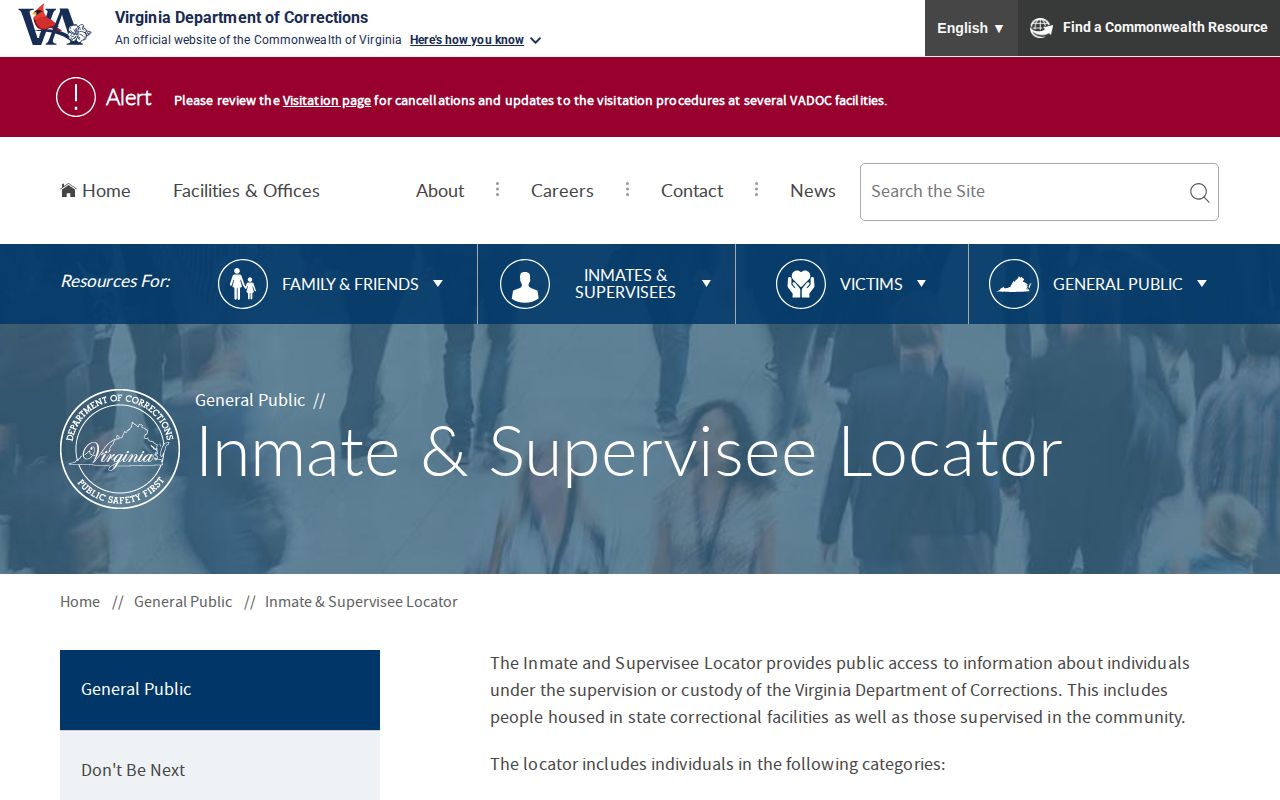
The form’s name, DOC ID, and optional filters help distinguish a state record from the earlier Prince William ADC custody stage.
- Open the VADOC Inmate and Supervisee Locator and accept its disclaimer.
- Enter the first three letters of the first name and the full last name, or use the seven-digit DOC ID.
- Add location, race, gender, or age-range filters only when they help distinguish a likely match.
- Remove optional filters if a plausible record is missing, then compare DOC ID, name, age, location, and case history.
- Open the individual result and record the exact status, location, and date labels displayed that day.
- Confirm an actual release with a later notification, release document, or VADOC records response.
A no-result has limits. A fully discharged person may have a different public presentation or may not be returned by the current locator. Name differences and data timing can also affect results. State only what the observed record reports, preserve the date checked, and avoid turning an absence into proof of release.
VADOC Records and Contact
Because this page covers a statewide system rather than one prison, the contact card identifies VADOC's verified general channel and locator. The supplied research does not provide a single state-facility street address or public records-office hours suitable for every Prince William case. Use the institution or district shown on the individual result when a specific placement is known.
Virginia Department of Corrections
System: State prisons and VADOC Community Corrections
General phone: 804-674-3000
Online search: Inmate and Supervisee Locator
Facility and office directory: VADOC Facilities and Offices
Public hours: No universal records-office hours were verified in the supplied research.
For releasable projected dates or formal record handling, identify the person by DOC ID when possible and ask VADOC for the correct records route. Operating Procedure 050.1 recognizes projected parole-eligibility, mandatory-parole, and good-time release dates as releasable at the time of inquiry. Ask for the applicable label rather than assuming every public locator record shows the same field.
Prince William VADOC Placements
There is no VADOC prison identified within Prince William County in the current directory reviewed for this project. That fact matters. A person sentenced to a longer term may be held temporarily at the Prince William–Manassas Regional ADC and then transferred to any suitable state facility. The ADC tracks its own custody stage and transfer, while VADOC controls the state sentence calculation and later state release process.
The local and state date responsibilities also differ. ADC Inmate Records calculates local sentences ranging from one day through 12 months when imposed by Prince William courts. A sentence of one year or longer will likely move into VADOC's computation. Court arithmetic alone cannot replace the custodian's calculation because jail credit, sentence structure, earned credits, amended orders, warrants, detainers, discipline, and parole action can affect the result.
A departure from ADC to a VADOC institution is a transfer into state custody, not release to the community. Follow the statewide locator after the handoff.
VADOC Projected Release Dates
A projected date is a forecast based on the record and law in effect at the time of calculation. It is not proof that a release happened. VADOC procedures recognize projected parole eligibility, mandatory parole, and good-time release dates. If an individual locator page displays a date, preserve the exact field label and the date of the lookup. If it does not, use the official contact route and ask about the relevant projected date recognized by Operating Procedure 050.1.
Virginia's earned-sentence-credit system is more specific than the common “85 percent” shorthand. The standard rate associated with 4.5 days of credit for each 30 days served produces about 86.96 percent of the credit-adjusted period, not an exact 85 percent promise. Current law also distinguishes restricted ESC-1 offenses from eligible ESC-2 offenses with different levels. Offense date, offense category, conduct, program participation, and transition rules matter. Never calculate a person's release from a charge label alone.
| Factor | Why the projected date may change |
|---|---|
| Sentence structure | Concurrent and consecutive terms change the effective total. |
| Jail credit | Court-awarded time already served must be applied correctly. |
| Earned credits | Rate, classification, conduct, programs, forfeiture, or restoration can alter the calculation. |
| Court action | An amended order or uncalculated sentence can change the controlling record. |
| Warrant or detainer | Another authority may require continued custody or transfer. |
| Parole action | A grant, denial, or later release planning step affects the path but is not itself gate release. |
The Prince William inmate release date page gives the full local-versus-state computation path. After the projected day passes, look for an actual status, notification, or release document.
VADOC Actual Release Review
Operating Procedure 050.3 describes release as a controlled records process. Staff review the current corrections record and historical materials, then check for unsatisfied warrants, detainers, court orders requiring continued custody, classification or disciplinary action that affects the date, and uncalculated sentences. A discretionary parole case also depends on the Virginia Parole Board grant letter. Mandatory or good-time releases appear through the corresponding system reports.
At release, the person receives and signs applicable documents. Examples in the research include an Order of Release, Conditions of Probation, or Conditions of Parole. The public VADOC facility-release page states that discharge or parole release occurs by 11:59 p.m. on the release date, weather permitting. That statewide outer statement should not be turned into a promised pickup time or exit point for a particular institution.
A parole grant is not the same event as physical release. VADOC must still complete planning, records review, authorization, and any warrant or detainer checks. Likewise, a court sentence date does not show when a person crossed the facility gate. The best proof comes from the agency record closest to the completed event.
VADOC Release Notifications
VADOC's current victim-notification program is called NAAVI. It is separate from Virginia Jail VINE, which covers named people reported by participating local and regional jails. A person with a sentence of 12 months or more may remain physically in a local jail while VADOC calculates the state sentence, so the official workflow may require following the local jail track while housed there and the state notification process as applicable.
An anticipated VADOC release notice is normally sent about 30 days before the expected date. It remains a forecast and can change. An actual-release notice means the person is no longer in VADOC custody, and the state notifications cease after release. Preserve the event date and identifiers, then compare the notice with the locator and release record.
Leaving VADOC custody does not prove the absence of supervision, a federal or immigration hold, or a later case. Describe the event narrowly as release from the state system unless a separate source establishes the person's broader status.
VADOC Supervision After Release
VADOC Community Corrections supervises probationers, parolees, and other eligible released people. Prince William County, Manassas, and Manassas Park are served by District 35 in Manassas. A locator result naming a district office places the person on the community-supervision side of VADOC's system. It does not mean the person is incarcerated at that office, and it does not prove the exact time they left ADC or a prison.
Virginia parole and probation have different legal sources. The Virginia Parole Board decides discretionary or geriatric parole in the categories where it remains available. Probation can follow a court sentence without a parole decision. Most felony conduct committed on or after January 1, 1995 falls under Virginia's abolition-of-parole framework, subject to statutory exceptions. Eligibility cannot be inferred from age, offense name, or sentence length alone.
- Parole
- Conditional release from prison under authority of an eligible parole decision and VADOC release process.
- Probation
- Court-ordered community supervision that may follow a sentence without parole.
- Discharge
- The end of the identified custody or supervision obligation documented by the responsible authority.
- Detainer
- A request or legal basis for another authority to hold or receive a person when one custody term ends.
Request VADOC Release Records
When the locator or phone inquiry cannot answer the question, request an existing record from VADOC. Provide the full name, seven-digit DOC ID if known, the approximate custody period, and the exact record or date field sought. Ask for the projected parole-eligibility, mandatory-parole, or good-time release date only when that label fits the case. For a completed event, identify the release, parole, probation, or discharge document needed.
Do not send the request to the ADC merely because the Prince William case began there. ADC can hold its own booking, local sentence, and transfer record. VADOC controls the later statewide custody and release record. Courts maintain their own orders through clerk access procedures. Keeping those custodians separate produces clearer responses and avoids mistaking a no-record answer for proof that no state custody existed.
Virginia FOIA provides an access framework for covered state and local records, but exemptions, requester rules, and actual-cost charges can apply. Request existing documents rather than asking open-ended questions. If a portion is withheld, ask the agency to identify the legal basis. If no responsive record exists, preserve the answer and check whether another VADOC unit, the court, or the earlier local custodian created the relevant document.