
Prince William Parole Versus Probation
Virginia assigns two separate roles to state agencies. The Virginia Parole Board decides discretionary parole and geriatric conditional release in the categories where those forms of release remain lawful. VADOC Community Corrections supervises parolees, probationers, and other eligible people after release. A Prince William County court can order probation as part of a sentence. That court action does not require a Parole Board grant.
Virginia abolished discretionary parole for most felony conduct committed on or after January 1, 1995. Exceptions and older sentences remain. Eligibility depends on the complete offense and sentence record, not just age or term length. Virginia Code § 53.1-151 sets many parole eligibility rules and exclusions, while § 53.1-40.01 addresses geriatric conditional release. Neither statute supports estimating eligibility from a charge name alone.
| Point | Parole | Probation |
|---|---|---|
| Who creates it | Virginia Parole Board for an eligible prison sentence | A sentencing court |
| When it occurs | After release from prison custody under a grant | As ordered, often after confinement or as a suspended sentence term |
| Who supervises | VADOC Community Corrections | VADOC Community Corrections in covered adult cases |
| Best public check | Board decision plus VADOC locator result | Court order plus VADOC locator result |
- Parole
- Conditional release from prison for a sentence that remains parole-eligible.
- Probation
- Court-ordered supervision in the community, often tied to a suspended sentence.
- Discharge
- The formal end of supervision or sentence obligations shown by the responsible authority.
- Absconder
- A person alleged to have stopped reporting or left supervision without approval; the label must be verified.
Check Prince William Supervision Status
The VADOC Inmate and Supervisee Locator is the first public check for Prince William County supervision. It covers incarcerated people and people assigned to probation or parole district offices. The locator updates daily, but VADOC warns that entries may be inaccurate or out of date. A result should therefore be read with the order or decision behind it.
- Search with the seven-digit DOC ID when known. Otherwise, enter at least the first three letters of the first name and the full last name.
- Remove optional location, race, gender, or age filters if they exclude a plausible match. Never choose a record from the name alone.
- Open the individual result. Compare the DOC ID, name, age, location, and case history with known facts.
- Read a District 35 or other district-office location as community supervision, not incarceration and not proof of the ADC release time.
- Match probation to the sentencing or revocation order. Match parole to the Board decision, then confirm the current VADOC status.
The official locator screen shows the inputs and coverage used for that check. View the current VADOC search interface before relying on its labels.
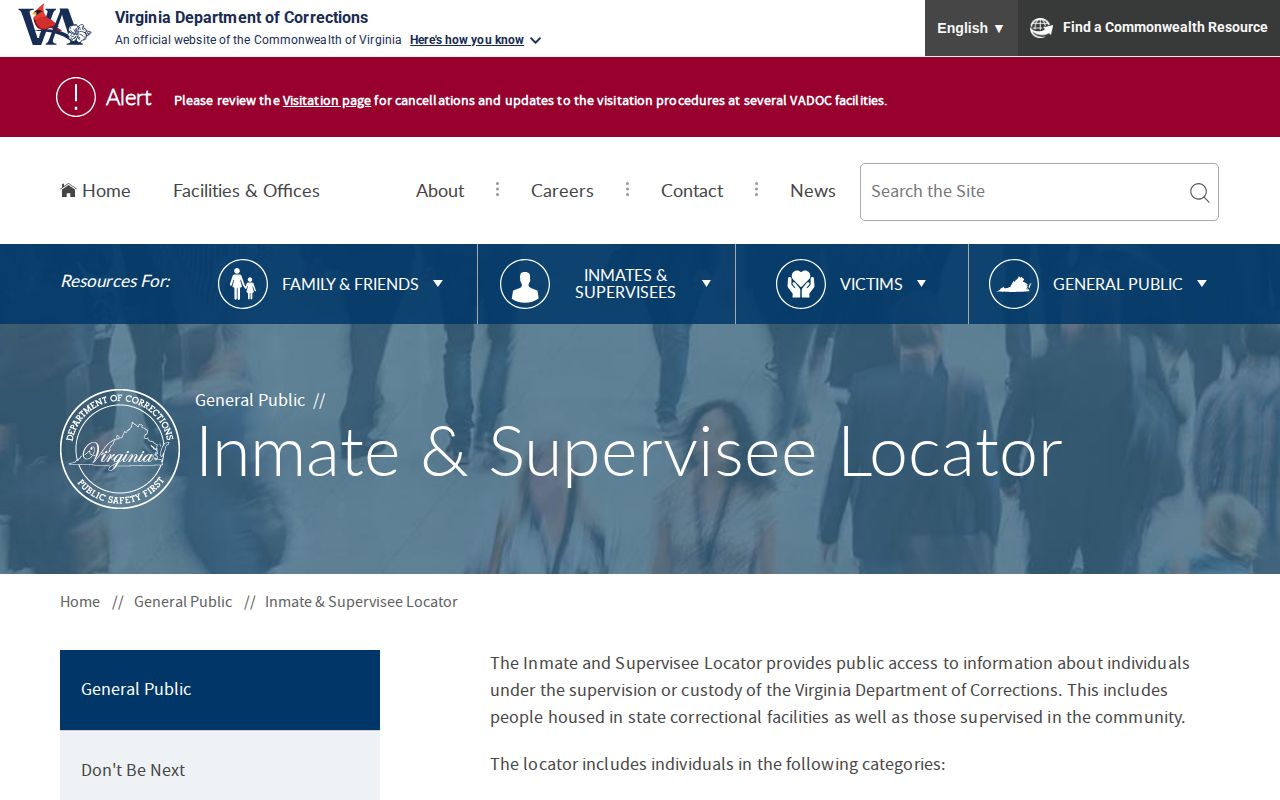
The captured interface confirms that the public search spans both inmates and supervisees. Date-stamp any result because status and office assignments can change.
Prince William Probation District 35
Prince William County, Manassas, and Manassas Park are served by the Manassas probation-and-parole office identified as District 35 in VADOC material. When an individual locator result points to that office, District 35 can provide administrative direction. Staff may not disclose protected case-management details. The public result and the governing court or Board document remain the sound starting points.
VADOC District 35
Manassas Probation and Parole
Serves Prince William County, Manassas, and Manassas Park
Confirm the current office listing and contact details
VADOC main line: 804-674-3000
A person can be released from the Prince William–Manassas Regional Adult Detention Center without entering District 35 supervision. Bond, recognizance, time served, or a transfer may lead elsewhere. Conversely, a District 35 supervisee may have come from a VADOC facility outside the county. The office listing answers where supervision is managed, not where the person was held.
Note: Confirm the district on the live individual result before contacting an office, since residence, court action, or case administration can change an assignment.
Prince William Parole Decision Records
The Virginia Parole Board publishes Monthly Decisions. Those reports may show the people considered, offense, jurisdiction, sentence and time served, grant or denial, reasons, and votes. Decisions are not posted until the end of the next month so required notices can occur. That delay matters when a family is trying to reconcile a recent Board action with a current locator entry.
A grant is not physical release. VADOC must still conduct release planning and review warrants, detainers, court orders, sentence calculations, and authorization. A denial leaves custody unchanged. A deferral moves consideration to a later point. If a document uses another term, including rescission, read that exact decision instead of assuming its effect.
The Board calls its calendar channel Public Meetings. It is not a complete hearing calendar. When the Board is inclined to grant discretionary parole or geriatric conditional release, the current process includes a video meeting and an agenda posted at least three working days beforehand. Not every eligible person receives a public meeting, and the archive is event-driven rather than a fixed weekly schedule.
The monthly report image shows how decisions are organized and why the decision month matters. Check the Board's live report index for the newest publication.
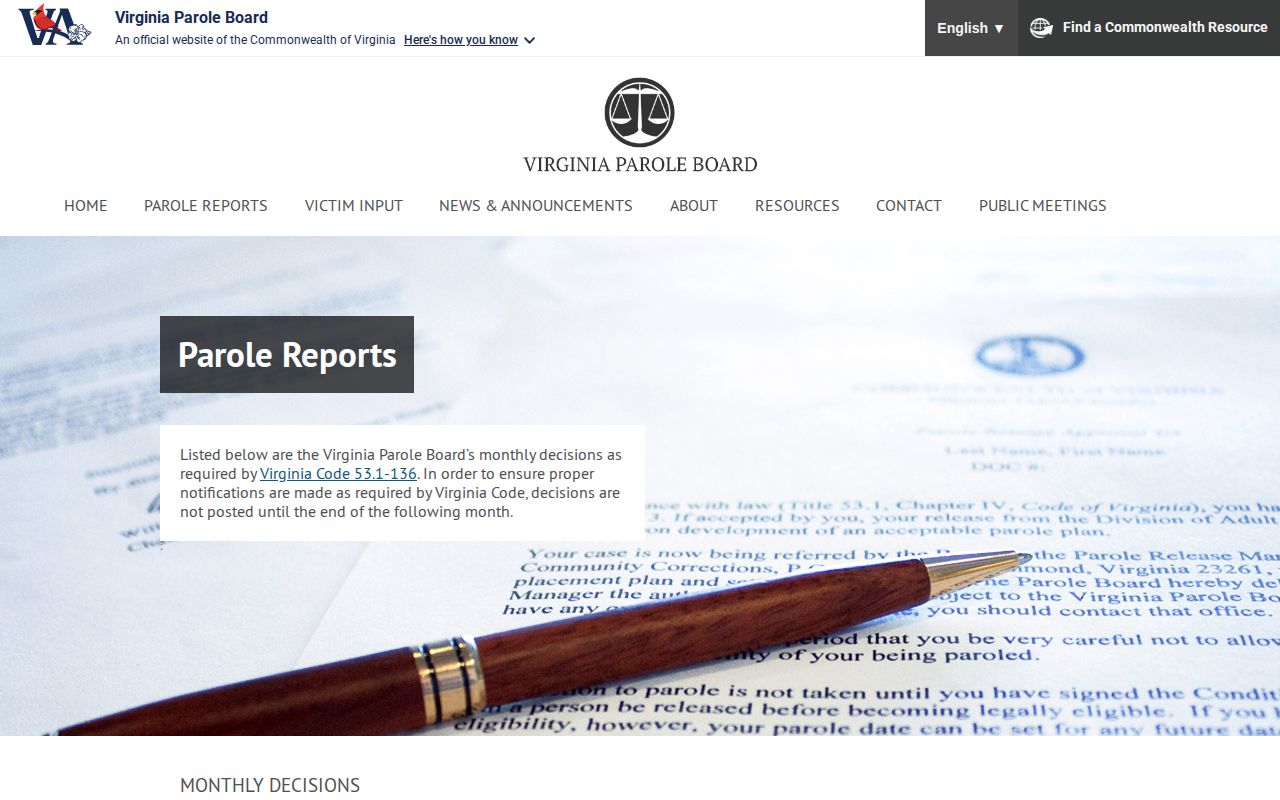
The report supplies decision context, while the later VADOC custody record or actual-release notice establishes what happened after a grant.
Prince William Probation Violations
Conditions of supervision come from the court order, parole conditions, and VADOC instructions. They can include reporting, approved residence or travel, treatment, payment terms, or other case-specific duties. The public locator does not expose the full supervision file. Only the governing documents and responsible office define the person's actual conditions.
An alleged violation can lead to a warrant, court hearing, revocation, or a return to custody. Revocation means a judge or other lawful authority withdraws some or all of a community-based disposition after a violation process. An absconder label means supervision staff allege that contact or compliance has been lost. Neither term proves that the person is already back in the Prince William ADC.
No official county-published absconder list specific to Prince William was found. Check VADOC, the Prince William adult court records, and the responsible law-enforcement channel. A Virginia Jail VINE alert can help if the person enters a participating local jail, but it is a custody notification service, not a probation case file.
Prince William Pretrial Release
Prince William Criminal Justice Services operates regular and intensive pretrial supervision for some defendants released by court order while charges are pending. Intensive supervision may include house arrest or electronic monitoring. That status is neither parole nor post-sentence probation. It explains why a person can lawfully leave the ADC while the criminal case remains open.
Use the Prince William pretrial supervision information with the court docket. A release order can identify the legal basis for departure, while the ADC release record can show the actual custody event. Calling pretrial supervision “parole” would obscure both the pending case and the agency responsible for it.
| Status | Record to check | What it establishes |
|---|---|---|
| Pretrial supervision | Release order and Criminal Justice Services record | Community monitoring while charges remain open |
| Probation | Sentencing or revocation order and VADOC result | Court-ordered post-sentence supervision |
| Parole | Board decision and VADOC result | Conditional release for a parole-eligible sentence |
Prince William Reentry Council
The District 35 resource directory identifies the Greater Prince William Area Reentry Council, periodic meetings or events, and Manassas probation-and-parole contacts. This local layer can help a released person or family find current points of contact. It does not promise a service, placement, benefit, or outcome.
Start with the directory, then verify the current event and contact details before relying on them. Reentry support and supervision have different roles. The council can help with navigation and community links, while District 35 administers conditions for people assigned there. A person who has fully discharged may use reentry resources without remaining on parole or probation.
Prince William Supervision Discharge
Supervision ends through a formal discharge, expiration, court action, or another authorized event shown in the responsible record. A missing locator result does not prove discharge. Search the final court order for probation, the Board's annual or monthly material for parole where relevant, and VADOC records for the supervision status at the time of inquiry.
The annual parolee final-discharge report linked by the Virginia Parole Board can be important when parole supervision itself has ended. For probation, later court entries may show completion, modification, or revocation. The Prince William County released-inmate search places those supervision records alongside the ADC release record and receiving-agency trail.
Keep each event separate: ADC release, VADOC release, supervision start, and supervision discharge are not interchangeable dates. That distinction prevents a community-supervision result from being mistaken for current incarceration or total sentence completion.